How Do They Get Cow Cells for Lab Grown Beef
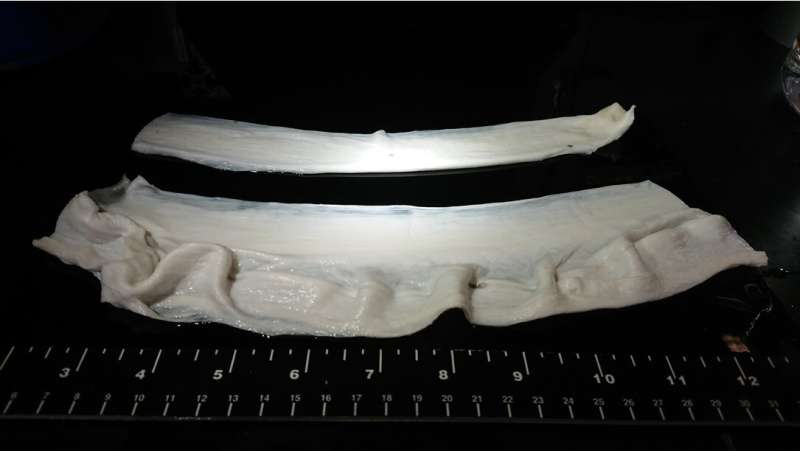
Lab-grown or cultured meat could revolutionize nutrient production, providing a greener, more sustainable, more ethical culling to large-calibration meat production. But getting lab-grown meat from the petri dish to the dinner plate requires solving several major problems, including how to brand big amounts of it and how to make it experience and taste more similar existent meat.
At present, researchers at the Harvard John A. Paulson School of Engineering and Applied Sciences (SEAS) have grown rabbit and cow muscles cells on edible gelatin scaffolds that mimic the texture and consistency of meat, demonstrating that realistic meat products may eventually be produced without the need to heighten and slaughter animals.
The inquiry is published in Nature Science of Nutrient.
Kit Parker, the Tarr Family Professor of Bioengineering and Applied Physics at SEAS and senior author of the study, began his foray into food after judging a competition show on the Food Network.
"The materials scientific discipline expertise of the chefs was impressive," said Parker. "After discussions with them, I began to wonder if nosotros could use all that we knew about regenerative medicine to the design of constructed foods. Subsequently all, everything we accept learned about edifice organs and tissues for regenerative medicine applies to food: healthy cells and healthy scaffolds are the building substrates, the design rules are the same, and the goals are the same: man health. This is our first try to bring hardcore engineering pattern and scalable manufacturing to the cosmos of nutrient."
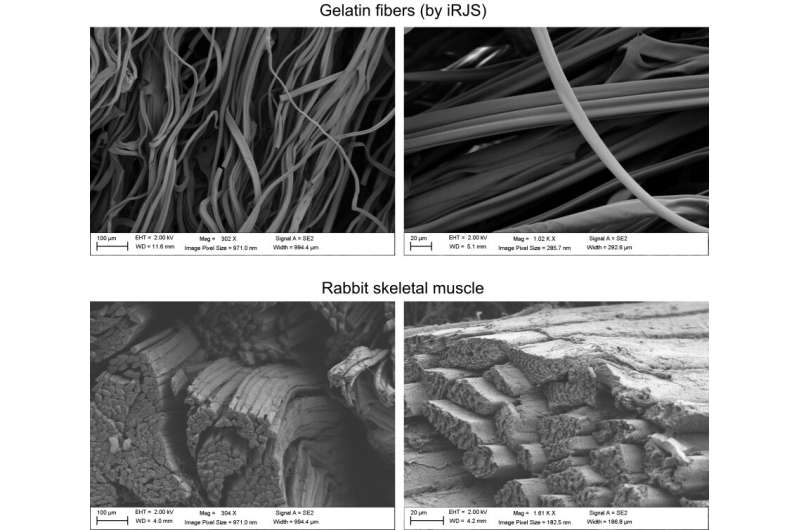
Animal meat consists by and large of skeletal muscle (and fat tissue) which abound in long, sparse fibers—as can be seen in the grain of a steak or when shredding pork or chicken. Reproducing these fibers is one of the biggest challenges in bioengineering meat.
"Muscle cells are adherent prison cell types, meaning they need something to hold onto equally they abound," said Luke Macqueen, commencement author of the study and postdoctoral fellow at SEAS and the Wyss Plant for Bioinspired Engineering. "To grow musculus tissues that resembled meat, nosotros needed to find a 'scaffold' material that was edible and allowed muscle cells to attach and grow in 3-D. Information technology was important to notice an efficient way to produce big amounts of these scaffolds to justify their potential utilise in food product."
To overcome these challenges, the researchers used a technique developed by Parker and his Disease Biophysics Group known equally immersion Rotary Jet-Spinning (iRJS), which uses centrifugal force to spin long nanofibers of specific shapes and sizes. The team spun food-condom gelatin fibers to course the base for growing cells. The fibers mimic natural musculus tissue's extracellular matrix—the glue that holds the tissue together and contributes to its texture.
The team seeded the fibers with rabbit and cow muscle cells, which anchored to the gelatin and grow in long, sparse structures, like to existent meat. The researchers used mechanical testing to compare the texture of their lab-grown meat to real rabbit, bacon, beef tenderloin, prosciutto and other meat products.
"When we analyzed the microstructure and texture, we found that, although the cultured and natural products had comparable texture, natural meat contained more than muscle fibers, pregnant they were more mature," said Macqueen. "Muscle and fat cell maturation in vitro are however a actually big claiming that volition take a combination of avant-garde stalk cell sources, serum-complimentary civilisation media formulations, edible scaffolds such every bit ours, as well as advances in bioreactor culture methods to overcome."
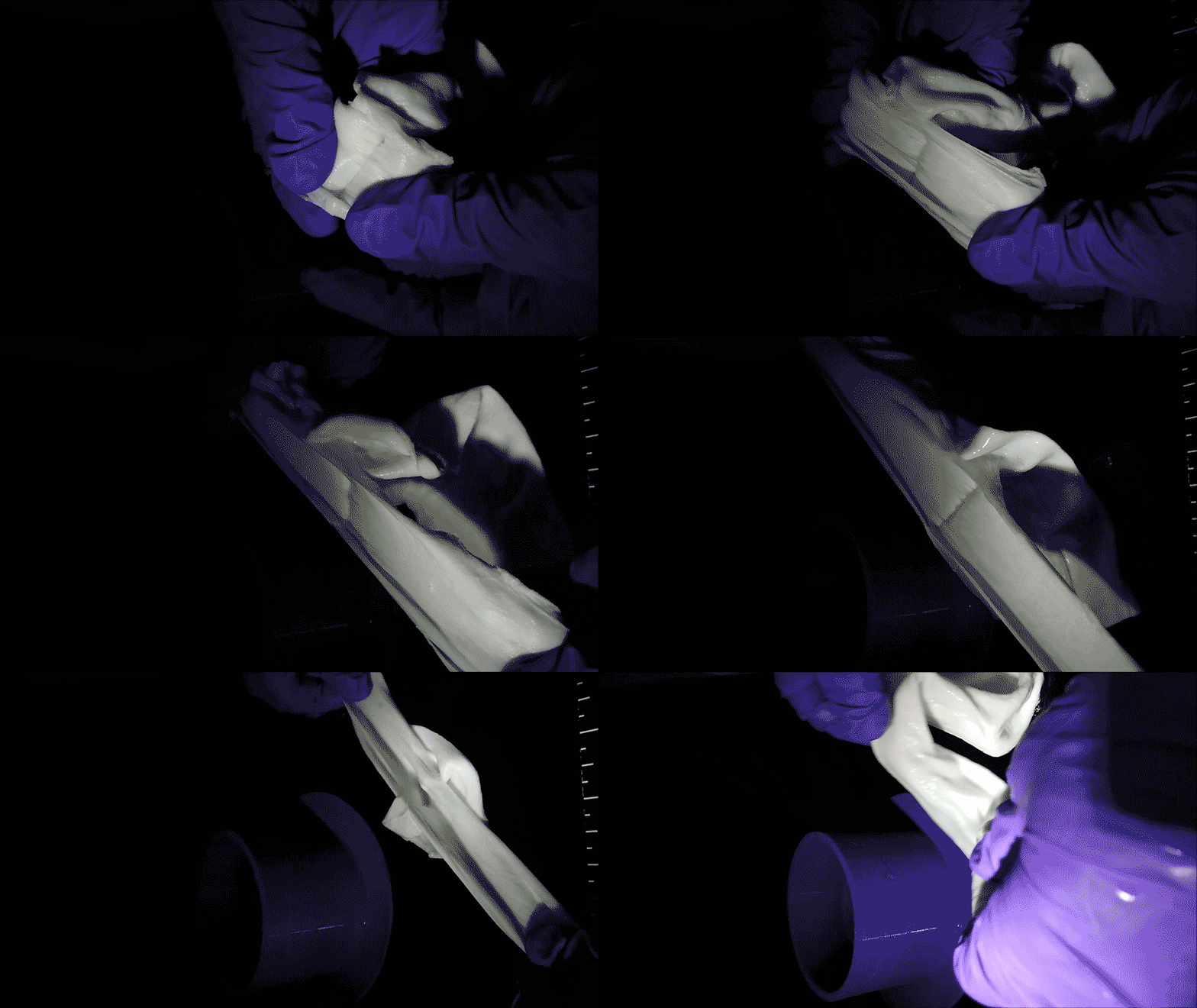
Still, this inquiry shows that full lab-grown meat is possible.
"Our methods are always improving and we have clear objectives because our design rules are informed past natural meats. Eventually, we think it may be possible to design meats with defined textures, tastes, and nutritional profiles—a flake similar brewing," said Macqueen.
"Moving frontward, the goals are nutritional content, gustatory modality, texture, and affordable pricing. The long-range goal is reducing the environmental footprint of food," said Parker.
"The development of cultured meat involves a number of technical challenges, including the formulation of a scaffold material that can successfully support cells and the development of prison cell lines that are amenable to cultivation for consumption at calibration," said Kate Krueger, Enquiry Director at New Harvest, a cellular agriculture inquiry institution, who was not involved in the research. "The authors of this publication accept adult scaffold materials that bear witness great promise in these areas."
Citation: Lab-grown meat: Researchers grow musculus cells on edible fibers (2019, Oct 21) retrieved 31 May 2022 from https://phys.org/news/2019-10-lab-grown-meat-musculus-cells-edible.html
This document is subject to copyright. Apart from any fair dealing for the purpose of private written report or research, no role may be reproduced without the written permission. The content is provided for information purposes only.
Source: https://phys.org/news/2019-10-lab-grown-meat-muscle-cells-edible.html
0 Response to "How Do They Get Cow Cells for Lab Grown Beef"
Post a Comment